NomadLink — UX Case Study
Balancing stability for digital nomads and trust for employers
Balancing stability for digital nomads and trust for employers
Remote work has gone mainstream after COVID-19, fueling a fast rise in digital nomadism. In 2023 there were ~35 million digital nomads worldwide. While the lifestyle offers freedom, it also brings unstable income, delayed payments, and time-zone friction. Employers benefit from global talent, yet struggle with trust, skill verification, and filtering quality candidates.

For nomads: unstable income, platform overcrowding, payment delays, credibility hurdles, and time-zone barriers. For employers: trust concerns, overwhelming applicant volume, communication challenges, and missed deadlines.

Design NomadLink — a platform that balances both sides. For nomads: trusted, flexible projects; verified payments; less noise. For employers: verified profiles and ratings; time-zone/skill filters; simpler communication and tracking.


Understand nomad motivations; pain points across search/apply/manage flows; employer hiring challenges; trust and workflow barriers (payments, time-zones, comms); and competitor gaps across Upwork, Fiverr, and Nomad List.
As part of my research, I created a Google Form survey to gather insights from digital nomads and employers.
Click here to view the Research FormKey findings: flexibility is the main motivation; income instability is the biggest challenge; employers are open to remote hiring but worry about trust; popular platforms have high competition/fees and limited quality control. Countries like Portugal, Spain, and Estonia introduced nomad visas; Europe is a hotspot thanks to safety and coworking infrastructure.

To gain real insights, I conducted a short survey and interviews with both digital nomads and employers. Below are selected quotes that highlight key frustrations and motivations.
“Freedom to travel but stress about what’s next and getting paid on time.” — Ayesha (UX Designer)
“Hard to filter serious candidates; time-zones caused day-long response delays.” — Philip (Startup Founder)
“I love the flexibility of freelancing, but I wish platforms would promote quality over quantity.” — Lucia (Content Strategist)
“Sometimes payments are delayed for weeks — it makes it hard to plan or feel secure.” — Jonas (Frontend Developer)
These insights confirmed that both sides share a need for greater trust, stability, and efficient collaboration.
Strength: scale, escrow
Weakness: intense competition, high fees
Strength: fast, clear pricing
Weakness: one-off gigs, variable quality
Strength: community & destinations
Weakness: not work-matching
Gap: no platform combining trust, time-zone coordination, and community.
Income insecurity, crowded platforms, payment risk, time-zone stress; want verified payments, time-zone matching, and skill verification.

Trust and relevance; overwhelmed by volume; value clear communication and proven skills; want better filtering, secure payments, built-in comms.

How might we provide secure, flexible, project-based work for digital nomads while giving employers confidence to hire skilled, reliable freelancers?

Seeks consistent, well-paid projects, verified payments, time-zone/skill matching.

Needs filtered, verified talent, secure contracts, easy scheduling and communication.
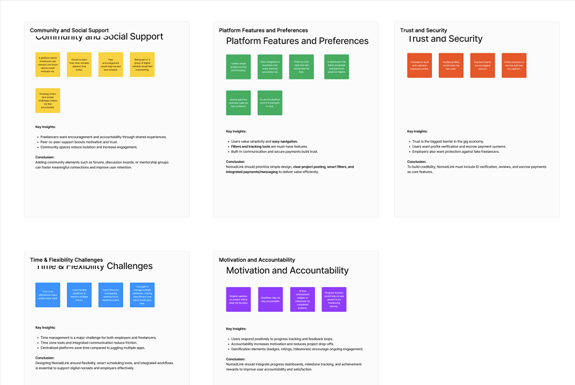
Concept exploration focused on trust signals (verification, ratings), scoped project briefs, time-zone aware matching, and lightweight project tracking. See Figma flows and screens for details.
Click here to view the Ideation in FigmaEnd-to-end flows for posting a project, applying, screening, contracting, and tracking. Time-zone overlap and escrow checkpoints are emphasized.
Click here to view the User Flows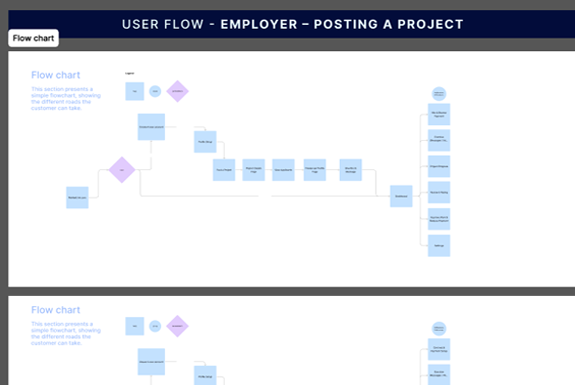
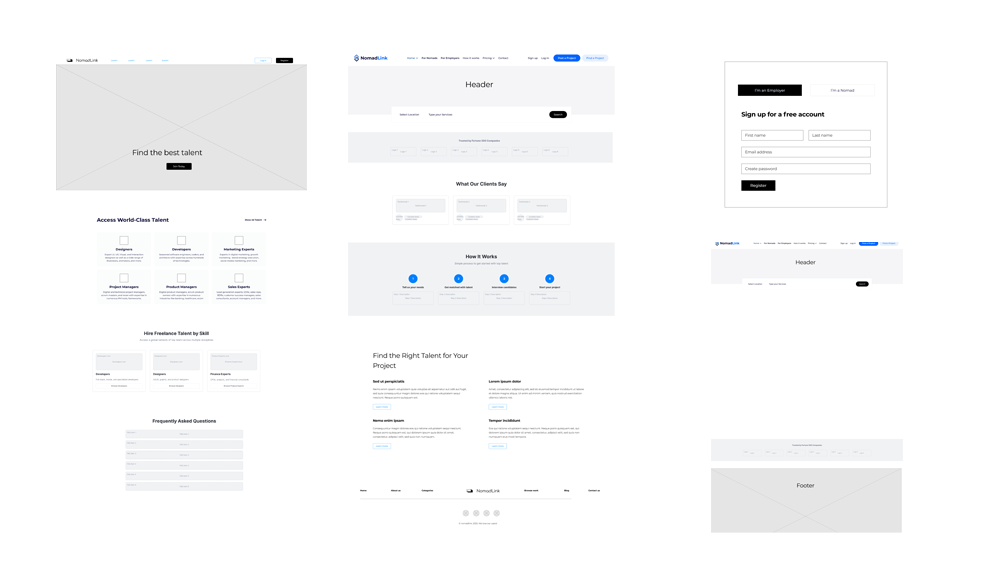
Low-fidelity frames explored dashboard cards, candidate filters, and profile credibility modules before moving to high-fidelity screens.
If you’d like to explore the actual Figma wireframes in detail,
Click here to view on Figma
High-fidelity interactive prototype demonstrating search, match, contract, and tracking experiences.
Click here to view the Prototype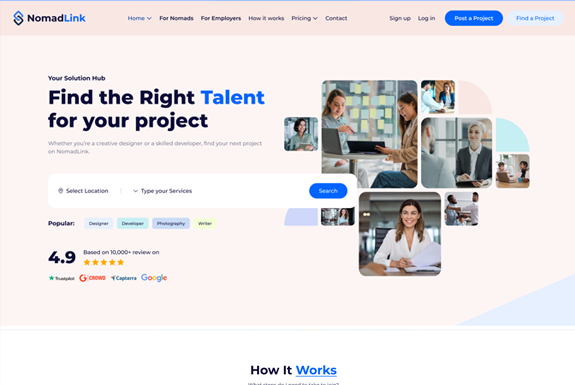
Trust comprehension, filter utility, and handoff clarity.
Clearer contract states and more visible time-zone overlap.
Validate communication flows across async work weeks.
